1949-1968

1949-1968 | 1969-1975 | 1976-1990 | 1991-2004 | 2005-Present

1949

The Lippard Report

A State-commissioned study headed by Dr. Vernon Lippard recommended establishing a state medical center and college at the University of Florida. The report outlined the need for colleges of medicine and nursing, as well as a dental school. 

Vintage headshot of Dr. Vernon Lippard from old newspaper clipping
Who was Dr. Vernon Lippard?

Dr. Vernon Lippard, dean of the Louisiana State University Medical School, was appointed by Florida’s Board of Control and State Board of Education in 1948 to lead a commission determining the ideal site for the state’s proposed medical and dental colleges. Legislators and medical professionals trusted Lippard as an objective, out-of-state medical authority whose professional qualifications were respected across the region.

Newspaper clipping headline from The Miami Herald
Fri, May 13, 1949 reads: "Gainesville Site Voted Best For Medical School"
Headline appeared in The Miami Herald on May 13, 1949

Miami, Jacksonville and Tampa were the primary contenders vying against Gainesville for the proposed medical center, though Orlando, Clearwater and Polk County also submitted bids.

“The study committee said it advocated Gainesville because the University already is offering many courses needed by medical students and because the School of Medicine would benefit by being in the closest possible touch with its parent institution.” — Florida Times-Union | May 14, 1949, ‘Three Cities Bid

Why Gainesville?

Lippard concluded that the state’s new medical, nursing and dental schools should not be scattered across various metropolitan clinics, but rather administered centrally as an integrated division of the state’s land-grant university. The report emphasized that the new health center would greatly benefit from being in the closest possible touch with its parent institution, the University of Florida, which was already offering many of the foundational courses required for medical students.

State legislators, heavily influenced by the advocacy of Gainesville State Senator W.A. “Bill” Shands, ultimately deferred to Dr. Lippard’s objective expertise. They favored the long-term educational benefits of a consolidated, university-based teaching center over the immediate financial savings and existing infrastructure offered by the larger cities.


1952 – 1953

Black-and-white newspaper photograph beneath the headline, “PROPOSED MEDICAL CENTER AT UF STUDIED BY VISITOR.” Two individuals in business suits stand indoors beside a large display model or rendering of a proposed University of Florida Medical Center complex. The model shows several modern multi-story buildings arranged across a landscaped site. One person gestures while speaking to the other as they examine the proposed development. The accompanying caption explains that the visitors are discussing plans for the University of Florida's proposed Medical Center and Florida Center of Clinical Services during a campus consultation visit.

In 1952, UF President J. Hillis Miller initiated the Medical Center Study to assess Florida’s growing healthcare needs and plan the university’s medical infrastructure.

Professional photo of Dr. Richard S. Poor from a 1956 Tampa Bay Times newspaper article.
Dr. Russell S. Poor (Tampa Bay Times, 1956)

Financed by a grant from the Commonwealth Fund rather than a $100,000 state appropriation, the planning process operated independently of state politics.

Directed by Dr. Russell S. Poor and involving College of Medicine founding dean Dr. George T. Harrell and Health-Related Services founding dean Dr. Darrel Mase, the 1953 study resulted in a five-volume report recommending the integration of a College of Dentistry into the Health Center complex. Dr. Poor subsequently became the first Provost of Health Affairs.

The findings documented the state’s severe medical and dental manpower deficits caused by post-war demographic shifts.

The report provided the demographic, macroeconomic and logistical justification for establishing a dental college alongside colleges of medicine, nursing, pharmacy and health-related professions within one integrated complex.


1957

Newspaper clipping with the headline “State Dentistry School Act Signed by Collins.” The article reports that Governor Collins signed legislation establishing a school of dentistry at the University of Florida. The brief news item states that the school would operate in conjunction with the existing medical school and that there were no immediate plans to begin a dental school program.
Newspaper clipping from The Florida Times-Union | May 22, 1957

On May 21, 1957, then Governor LeRoy Collins signed a legislative act “establishing” a school of dentistry at the University of Florida. However, funding stalled for several years.

Bill Shands vintage headshot from newspaper clipping

Senator W.A. "Bill" Shands

An early advocate

Amid heavy political fighting around the designated location for a state medical center, Senator Shands was an influential voice for Gainesville. "Bill Shands served in the Legislature during the critical war years and in the difficult post-war years when so many problems confronted the State and especially a fast-growing institution such as the University of Florida. Inasmuch as the University is in his Senatorial district, it was both right and proper that he should champion its needs, although it is my belief he did so, not as a partisan of Alachua county, but as a statesman looking after one of the greatest enterprises in the State. He ever regarded the University as a State agency and not simply a local one." — University President-emeritus John J. Tigert quoted in a May 1956 Sarasota Herald-Tribune article


A 1962 newspaper article illuminates rationale for dental college

St. Petersburg Times | Monday, February 5, 1962

“State Pays Sum Of Dental College To Train Dentists Out Of State”

GAINESVILLE — Florida has spent $6 million since 1945 subsidizing the education of students of dentistry at out-of-state colleges. With the same amount of money, the state could have built its own dental college.

About 50 Florida residents each year study to be dentists at out-of-state schools. The state each year pays $1,500 for each student to the school at which they study. The plan began 16 years ago to encourage state students to pursue careers in dentistry.

Some 1,000 Florida dentists have been trained at out-of-state schools with $6,000 of each of their four-year tuitions paid by the state under a plan originated 16 years ago. At the present time the state invests about $75,000 a year in training dentists.

Legislation passed in 1959 designates that Florida build a dental college at the University of Florida. But the act mentions no time for this to take place nor does it appropriate any money for the construction.

Dr. Russell S. Poor, provost of the University of Florida’s J. Hillis Miller Health Center, says the state’s dental association must show some initiative if the dental college ever is to be built.

“They must approach the legislature and ask for an appropriation to study and outline a plan for building the school,” Dr. Poor said.

Florida’s dentists are becoming more interested in building a dental school for two reasons, according to Poor. First, the acceptance rate of Florida dental students is declining every year. In addition, since there is a national shortage of dentists, Poor said the out-of-state dental colleges feel Florida is draining their talent.

The University of Florida has reserved land next to the health center for a dental school, but no other plans have been made. Poor said the University of Miami is also considering a dental college.

“The health center’s teaching hospital was designed to treat the whole man,” said Dr. Poor. “By adding a dental college, we could train people in all areas of medicine and develop a team approach to health.”

Dr. Poor will address the Florida Dental Society meeting in May. Poor said he plans to discuss the problem of educating Florida dental students at the meeting. Dr. Donald Morrison Sr., chairman of the Florida Dental Society’s education committee, said the meeting plans to consider the possibility of a dental school in Florida.


1963

Newspaper clipping with the headline “Dental College for UF In 5 Years Is Endorsed.” The article reports that Florida dentists meeting the previous day endorsed a plan to establish a full-fledged dental college at the University of Florida within five years. The byline identifies the author as Carolyn Dart of the Times-Union staff.

February 21–23 » To quantify the state’s specific needs, the Florida Dental Society held a workshop analyzing data on dental manpower requirements and needs in the state. Led by the group’s president, Dr. Reuben Groom, delegates conclude that a quality school of dentistry should be established at the University of Florida promptly.

Florida Dental Society President expresses need, vision (1963)

The Florida Times-Union | Sunday, February 24, 1963

“Dental College for UF In 5 Years Is Endorsed” by Carolyn Dart

JACKSONVILLE — Florida dentists meeting here yesterday endorsed a plan to establish a full-fledged dental college at the University of Florida within the next five years.

Delegates to a three-day workshop sponsored by the Florida State Dental Society at the Roosevelt Hotel concluded their sessions with a vote of approval for a legislative request from the State Board of Control. The board has asked the 1963 Legislature for a $40,000 appropriation to finance an official study during the next two years of all problems involved in starting a dental school.

According to the plan, results of the study and a request for appropriations to start the school would be presented to the 1965 Legislature.

None Here Now

No dental college now exists in the state. Medical schools are located at the privately operated University of Miami and the state-supported University of Florida in Gainesville.

“The need is there,” said Dr. Reuben P. Groom of Jacksonville, president of the state dental society. “Approval for establishing a dental school at the University of Florida was unanimous at this workshop on dental manpower requirements in the state.”

“We also recommended that the school be established forthwith and promised that the dental society will cooperate fully with officials at the University of Florida in carrying out these plans,” he said.

Dr. Groom said the committee which would conduct the study would include officials of the University’s J. Hillis Miller Health Center. The group would work with the educational committee of the dental society.

$3 to $5 Million

“The dental school probably would cost between $3 and $5 million to establish,” he said. “Perhaps the first class could be enrolled in five or six years. In that case we’d have a graduating class in about ten years.”

The proposed school would be an independent college and the fifth in the University of Florida medical complex. Already established are colleges of medicine, nursing, pharmacy and health related services.

“The dental school we contemplate would be far beyond the average concept of such an institution,” Dr. Groom said. “It would emphasize preventive programs and research, attempting to prevent many present dental problems. It would have a program of post-graduate training, also.”

Has Pre-dental Course

He said the university already has an undergraduate pre-dental curriculum. With the establishment of a graduate dental college, undergraduates headed for medicine and dentistry would take the same courses leading to bachelors degrees.

“Even during their four years of dental school, students would undergo some training on regular medical wards so they and the physicians would have a mutual understanding of problems and roles,” Dr. Groom explained.

Details of training and manpower needs were discussed during each session of the workshop, which began Thursday morning. Organized by Chairman Dr. Lewis J. Marchand, it featured several dozen prominent dentists, doctors and educators.

Among the speakers were:

  • Dr. J. Broward Culpepper, executive director of the Board of Control
  • Dr. John C. Brauer, dean of the school of dentistry at the University of North Carolina
  • Dr. S. P. Martin, provost of the J. Hillis Miller Health Center of the University of Florida
  • Also appearing were:
  • Dr. Paul H. Jeserich, treasurer of the American Dental Association
  • Dr. Robert M. Denton, executive director of the Florida State Board of Dental Examiners
  • Robert Carter, research analyst of the Florida State Board of Health
  • Wylie Kilpatrick, research professor of the Bureau of Economic and Business Research at the University of Florida college of business administration.

Following the workshop, the State Board of Control requested a $40,000 appropriation from the 1963 Legislature to finance an official two-year study on starting the school. UF President J. Wayne Reitz appointed an advisory committee of 14 Florida dentists, chaired by Dr. Lewis Marchand of Gainesville, to assist the university with planning.

“This is an important step in the development of a first-rate college of dentistry at the university. We appreciate the confidence in the University of Florida that has been shown by the Florida State Dental Society and welcome the cooperation of the society in building a dental school of which the state may be proud.” — University President-emeritus Dr. J. Wayne Reitz quoted in an Aug. 1, 1963, The Times-Union Bureau article ‘Plans Group Named for Dental College’


1965

The Florida Legislature subsequently allocated $200,000 in explicit planning monies to recruit initial dental faculty and develop the curriculum and physical resources for the planned College of Dentistry.


1966

Newspaper article titled “Dental Dean Is Named” announcing the appointment of Dr. Edmund Ferris Ackell as the founding dean of the University of Florida’s planned College of Dentistry. The article describes the Board of Regents’ approval in 1966 and Ackell’s role in developing the college’s educational program and facilities.
Tampa Bay Times | July 15, 1966
Vintage Edmund Ackell headshot from old newspaper clipping
Dr. Edmund Ackell

In the summer of 1966, Dr. Edmund F. Ackell, an oral surgeon holding degrees in both medicine and dentistry, was recruited from Western Reserve University’s School of Dentistry in Ohio to serve as the UF College of Dentistry’s first dean.

Ackell arrived with a national reputation for advising the development of new dental facilities.

“The appointment of Dr. Ackell is an extremely fortunate one for the University of Florida. Dr. Ackell is eminently qualified to assume leadership of the state of Florida’s first College of Dentistry. He has performed with exceptional ability in the planning and building on dental programs as a consultant on national committees and as a member of the faculty at Western Reserve University. He is fundamentally interested in education and in devising programs of dental education which would develop dentists of the highest caliber.” — then University President Dr. J. Wayne Reitz quoted in a Friday, July 15, 1966 Florida Alligator article, ‘Ackell Named Dental College Dean’

Newspaper clipping titled “Dentist Gives UF Books, Tools” reporting that retired St. Petersburg dentist Dr. Robert R. Gillis donated more than 300 dentistry books, journals, and dental instruments to the University of Florida’s new College of Dentistry in 1966, including rare textbooks dating to 1900.
Tallahassee Democrat | Aug. 15, 1966

“Dr. Ackell’s broad experience in medical and dental education qualifies him to design a new and exciting program for Florida students. It is rare to find this breadth of experience. He brings us exceptional clinical experience and sensitivity to the problems of patient care. His assistance to the federal government in the area of dental education adds to his talents as a promising administrator for the Health Center’s dental college.”

— then Health Center Provost Samuel P. Martin quoted in same July 15 Florida Alligator article

Despite this grand vision, the college’s initial physical footprint was decidedly modest.

Ackell’s primary office was set up within the existing Medical Sciences Building, while the earliest faculty workspaces were relegated to “flavets”: that is uninsulated, temporary wooden barracks originally erected during World War II.

Historic photograph of an early University of Florida College of Dentistry classroom inside a temporary World War II-era Flavet building. Faculty members sit at workstations equipped with task lamps and dental models while an instructor demonstrates a dental appliance or study model at the front of the room.

1967

Dr. Jose Medina pictured in front of UFCD flavet, its early home, from a 1969 St. Petersburg Times newspaper clipping.
Dr. José E. Medina

Institutional momentum accelerated significantly in 1967 on both the academic and structural fronts.

On July 1, Dr. José E. Medina, previously the assistant dean and professor of operative dentistry at the University of Maryland, was appointed as the college’s associate dean and professor of clinical dentistry.

He was specifically tasked with designing the new curriculum, recruiting foundational faculty and developing the future clinical programs.

“Florida’s new College of Dentistry is extremely fortunate in securing Dr. Medina’s talents. He has been significantly involved in dental education for 19 years and is aware of the need for change in the education of the dentist of tomorrow. He has successfully developed improved clinical teaching at the University of Maryland, and was instrumental in the planning of a new structure for that University’s dental school.”

— then Dean Ackell quoted in summer (1967) publication for the health center

Simultaneously, Health Center Provost Samuel P. Martin unveiled “Project I,” an ambitious $30 million expansion plan designed to double the footprint of the 12-year-old medical complex.

A black-and-white photograph of two men looking down at a large tabletop architectural scale model of a building complex. One man is pointing at a section of the model with a pen. [Image Caption:] Architect to the Provost William C. Grobe and Draftsman Worth Crow inspect a model of the Health Center. The white portion represents the existing structure; the dark, the proposed expansion.

This architectural undertaking called for a five-level basic sciences building to centralize learning resources and an expanded library, alongside a new southwest extension specifically designed to house the College of Dentistry’s outpatient clinics, graduate programs and faculty offices.

Also in 1967, the Academy One Hundred was formally incorporated as a philanthropic support group to champion the new school.

Led by its founding president, Dr. E. Monroe Farber, this highly regarded group of practicing dentists held its first organizational meeting, establishing a private fundraising pipeline that would become instrumental in financing the college’s future clinical facilities and scholarships.


1968

January

A photograph shows seven men in suits gathered closely together, examining a document held by the man on the far right. Four men are standing behind three seated men.

First continuing education course held by UFCD

The College of Dentistry sponsored its first continuing education course in cooperation with the Florida State Dental Society.

Internationally recognized clinician Dr. Ralph W. Phillips conducted the two-day session, focusing on new dental materials and techniques.

March

Newspaper clipping from The Tampa Tribune dated March 5, 1968, with the headline “Regents Okay Big Expansion For the UF Health Center.” The article reports Board of Regents approval of a major expansion project at the University of Florida's J. Hillis Miller Health Center, including facilities for the state’s first College of Dentistry and other health professions programs.

Medical center expansion approved

The Board of Regents approved “Project I,” a $30 million building expansion program designed to double the Health Center’s footprint. The state legislature was then asked to appropriate $10 million, with the remainder to be funded by federal construction grants.

Summer

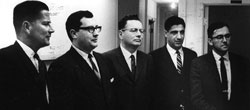
Historic photograph from the University of Florida College of Dentistry's first faculty meeting on March 13, 1968. Five founding faculty members stand together indoors shortly before the college welcomed its inaugural class later that year.

First UFCD department chairs hired

Tentative departmental structures were approved, and founding faculty brought international reputations to the new college.

Key appointments included Dr. Bruce H. Bell as chairman of the Department of Restorative Dentistry, Dr. William K. Collett as chairman of the Division of Radiology, and Dr. Harold R. Stanley as chairman of the Department of Oral Pathology.

Fall

Vintage photograph of the Gainesville Veterans Administration Hospital near the University of Florida campus. The multi-story hospital building is viewed from across a roadway, with traffic lights, utility poles, and a 1960s-era automobile visible in the foreground.

VA relationship takes root

A rotating internship was established between the dental school and the Gainesville VA Hospital, marking the first step in a close, long-term clinical partnership.

December

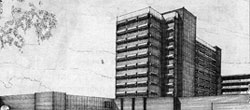
Architectural rendering published in a 1970 newspaper showing the planned University of Florida College of Dentistry building as part of an expansion of the J. Hillis Miller Health Center. The image accompanied a report on a $19.7 million National Institutes of Health grant supporting construction of Florida's state dental school.

Dental tower funded

The U.S. Department of Health, Education and Welfare approves a $19.7 million capital outlay grant for the Project I Health Center expansion, allocating $12 million of this total specifically to construct the College of Dentistry.

However, this federal funding remains legally locked and contingent on the State of Florida providing a matching $13.3 million share.

“Florida can no longer afford to rely on exporting its dental school candidates and importing its dentists” — 1968

The Florida Times-Union | Wednesday, March 6, 1968

“Dental School will Fill a Need”

JACKSONVILLE — Action by the Florida Board of Regents opening the way to the establishment of the state’s first college of dentistry at the University of Florida’s J. Hillis Miller Health Center fills a long-felt need in the state’s educational structure.

Florida is one of the few remaining states without facilities, either public or private, for professional training in dentistry. Floridians who wish to enter the profession must go elsewhere for their training, and the people of Florida must depend on graduates of out-of-state schools to serve the needs of the state’s rapidly expanding population.

Under the plan approved by the Regents, a building expansion program will be undertaken which will double the space at the health center on the Gainesville campus, to be financed one-third by the state and two-thirds by the federal government.

Plans call for admission of 40 entering dental students by the fall of 1971, and 60 by 1975. The expansion also will permit an increase in enrollment of medical students up to 100 annually, as well as more space for the College of Health-Related Professions and the College of Nursing.

Medical education authorities estimate Florida needs at least 300 entering medical students every year to keep pace with its needs, whereas the present schools at Gainesville and the University of Miami can accommodate fewer than half that number.

There is a logical tie between this lack of facilities and the fact that the state ranks far below the national average in number of entering medical students and in the number of practicing dentists, nurses and others in health and related professions in proportion to population.

There are many excellent dental schools in the country, some of them in the Southeast. One of the best known is that at the University of Tennessee Medical Division in Memphis. But like higher educational institutions of every kind, they are feeling the pressure of enrollment demands and must sharply limit admissions from other states and regions.

Georgia already is well advanced on a program to meet the challenge, with a dentistry school at the Medical College branch of the University system due to open this fall, and work under way on the new Emory University School of Dentistry in Atlanta.

Florida can no longer afford to rely on exporting its dental school candidates and importing its dentists.